Ham Radio CW Basics for New Operators
Voice gets you on the air; CW gets you through noise. This HF primer covers QSO basics, prosigns, licensing checks, and exam prep for new operators.
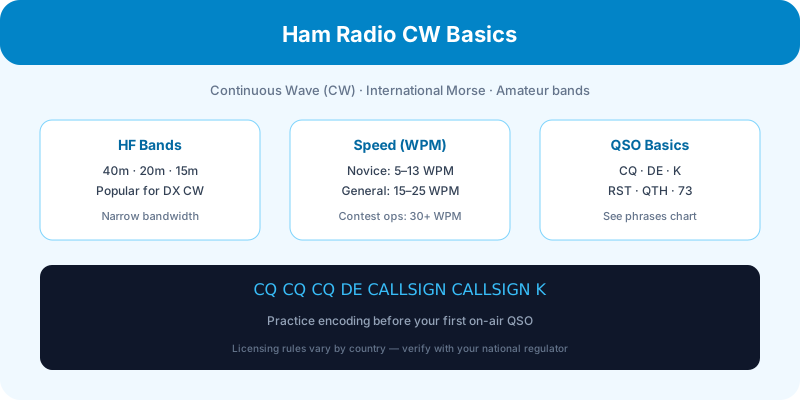
CW on HF — Why It Still Matters
Digital modes and voice dominate ham radio headlines, yet CW — continuous-wave Morse — remains the most bandwidth-efficient way to make contacts when conditions are marginal. A five-watt CW signal on 20 meters can span oceans that defeat fifty watts of SSB voice. For new operators, CW also offers a community of patient elmers, structured contesting, and a skill that transfers to historical telegraphy and emergency preparedness.
This primer covers HF CW basics assuming you hold or are pursuing an amateur license. Regulations differ by country — band privileges, power limits, and whether Morse appears on your exam change with jurisdiction. Always verify with your national regulator (FCC in the United States, RSGB/Ofcom in the UK, your IARU member society elsewhere) before transmitting.
HF Bands Where You Will Hear CW
Morse occupies dedicated sub-bands on most HF allocations. Beginners typically start on:
| Band | Approx. freq (varies by region) | Why beginners listen here |
|---|---|---|
| 40m | 7.025–7.125 MHz (CW segments) | Strong evening activity; NVIS regional contacts |
| 20m | 14.000–14.150 MHz | DX potential; busy but welcoming to slow CW |
| 15m / 10m | When open | Seasonal DX; listen for speed before calling |
Consult your band plan chart for exact segment boundaries — CW-only slivers exist separately from mixed-mode portions. Operating out of segment risks interference complaints even with good intentions.
QRS (slower please) to struggling callers.
Anatomy of a Basic CW QSO
Most casual HF contacts follow a predictable skeleton. International Morse prosigns — procedural signals sent without inter-letter spacing — mark transitions:
- Calling CQ —
CQ CQ CQ DE YOURCALL YOURCALL K - Answer —
OTHERCALL DE YOURCALL GM OM(time-of-day greeting varies) - Signal report — RST format: readability, strength, tone (e.g.,
599) - Name and QTH —
NAME JOHN QTH LONDON - Exchange / chat — Weather, rig, antenna, how long licensed
- Close —
TNX FB QSO HPE CUAGN 73 DE YOURCALL SK
Template phrases with Morse patterns live on /morse-code-phrases — encode each line on /text-to-morse and drill until muscle memory kicks in.
Essential Prosigns and Abbreviations
On-air CW compresses language through ITU-standard abbreviations and prosigns:
| Signal | Morse | Meaning |
|---|---|---|
| AR | .-. | End of message / pause |
| K | -.- | Over — your turn |
| KN | -.-. | Over to named station only |
| SK | ...-.- | End of work (silent key) |
| BT | -...- | Break / new paragraph |
Common abbreviations: OM (old man), QTH (location), FB (fine business), TU (thank you), 73 (best wishes). Do not invent shorthand — copy what you hear on band for a month before improvising.
Licensing and Exam Prep — Verify, Do Not Assume
Historically, many countries required Morse proficiency for full HF privileges. Several administrations dropped code tests while retaining CW as an operating mode. That split confuses newcomers who hear "no code exam" and assume CW is illegal — it is not, where your license grants phone and digital on a band, CW is almost always permitted too.
Before your first transmission
- Confirm your license class covers the band and power you plan to use
- Check whether any Morse element remains for upgrade paths in your country
- Identify club nets that welcome
QRStrainees — many schedule beginner-friendly speeds Tuesday evenings - Practice sending with a sidetone oscillator or paddle before connecting a live transmitter
Building Copy Speed for Real QSOs
On-air success requires head copy — writing what you hear in real time without falling behind. Build toward thirteen to fifteen WPM minimum for casual rag chews:
- Koch method — incremental letters; see /learn
- Farnsworth drills — 10 WPM characters, 15 WPM gaps until smooth
- Word practice — common QSO nouns from the phrases page
- On-air listening — one hour weekly minimum on your target band
morsecodetranslator.site provides browser-based encode/decode and WAV export for commute drills — no pop-up ads, no server upload of your call-sign practice texts. Pair online tools with ARRL or equivalent license manuals for theory; pair ear training with actual band monitoring for rhythm.
Equipment — Start Simple
You do not need a boat anchor transceiver to learn. Many operators practice months with:
- A receiver or SDR covering HF (receive-only is legal everywhere for listening)
- A cheap practice oscillator or app sidetone for sending rhythm
- A straight key or paddle when ready for live TX — many clubs loan gear
When purchasing TX capability, verify CW break-in (full QSK) if you plan contesting — semi-break-in works for rag chews. Antenna constraints matter more than key brand at beginner stage; a resonant wire beats an expensive key on a poor antenna.
SK ready to close, mentor on speed dial if available.
Your Next Steps on HF
CW rewards operators who combine regulatory diligence with daily ear work. Listen on forty meters this week. Copy three QSOs in a notebook. Encode your call sign until it flows without lookup. Join a club net advertising QRS tolerance. When your regulator's rules and your copy speed align, answer your first CQ — and enjoy the oldest conversation mode amateur radio still offers.
Contesting versus rag chewing — different CW cultures
Contest exchanges are minimal: call, serial, grid, thank you, next. Rag chews wander — weather, rigs, years licensed. Beginners should listen to both styles before calling CQ; contest weekends on 20m sound chaotic until you recognize the compressed format. Neither is wrong — match the band's mood. Sending a full weather report during a sprint contest earns silence; sending contest format during a Sunday morning rag chew earns confused ? responses.
QRP and CW — why low power loves Morse
QRP operators often prefer CW because narrow bandwidth and constant-envelope keying concentrate energy where receivers listen. A five-watt CW contact on 40m is routine; five watts voice is a challenge. If your license and antenna limit power, CW expands your reachable world — another reason new operators invest ear time even when voice feels easier at first.
Finding mentors and nets
Search local club listings for "slow speed CW net" or "code practice." Many groups run weekly sessions at ten to thirteen WPM with patient net controls. Online forums supplement but cannot replace live rhythm — static, timing quirks, and operator personality appear only on air. Pair net listening with phrase drills from /morse-code-phrases so vocabulary matches what you actually hear.
Exam prep when Morse remains on your syllabus
Some jurisdictions still test Morse for certain certificates or maritime credentials. Exam Morse is often plain text at fixed speed — no prosign shortcuts unless specified. Practice with the site translator at exact exam WPM, then copy random five-letter groups without Farnsworth if the syllabus demands it. Verify format with your exam authority; do not assume ham club folklore matches current test standards.
Logging your first contacts
After your first QSO, log time, band, RST sent and received, and speed estimate. Review logs monthly — many beginners discover they copy faster than they send, or vice versa. Target balanced growth: if copy exceeds send by more than five WPM, dedicate extra encoder and sidetone time before chasing DX.
Frequently Asked Questions
Do I need to learn Morse code for a ham license?
Which HF bands are best for CW beginners?
What prosigns do I need for my first QSO?
K (go ahead), KN (named station only), SK ( end), AR (out). Full list on /morse-code-phrases.