What is SOS in Morse Code?
SOS (... --- ...) is the best-known distress signal — not shorthand for "save our ship." Here is the real history, ITU timing, and when not to use a web translator.
The Signal Everyone Knows — And Misunderstands
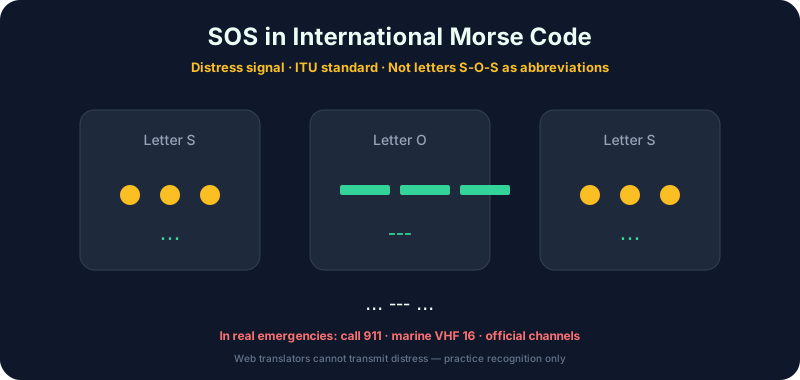
Three letters. Nine elements. Instantly recognizable even to people who have never touched a telegraph key. SOS in International Morse Code is ... --- ... — three dots, three dashes, three dots — yet popular culture still insists it means "save our ship" or "save our souls." It does not. The letters were selected at the 1906 Berlin Radiotelegraphic Conference for purely technical reasons: the pattern is unambiguous, fast to send with a hand key, and visually distinct on a tape printout.
Understanding SOS is practical safety literacy, not nostalgia. Mariners, aviators, and search-and-rescue trainees still study its rhythm. As a Morse learner, recognizing SOS by ear takes minutes; understanding when and how it is used takes a little longer — and knowing when not to use a website matters most of all.
Breaking Down the Pattern
SOS is three letters sent as a procedural signal, not a word. Each letter follows ITU-R M.1677-1 timing:
| Letter | Morse | Elements | Timing note |
|---|---|---|---|
| S | ... | 3 dots | Short-short-short; one unit each |
| O | --- | 3 dashes | Long-long-long; 3 units each |
| S | ... | 3 dots | Mirror of first S |
Standard letter spacing applies between S, O, and S when sending the group as text. In distress procedure, operators historically ran the nine elements as a continuous attention-getting burst before pausing to transmit position and nature of emergency. The key property is easy recognition — no similar common word uses exactly three of each element in sequence.
-.-. --.- -..), derived from the general call "CQ." SOS replaced it internationally because CQD could be misheard amid static. Both appear in Titanic-era accounts; SOS is the surviving global standard.
A Short History of Distress at Sea
Early wireless operators improvised distress calls until national administrations demanded harmonization. Germany proposed a dot-heavy pattern; Britain and others agreed on SOS as the universal radiotelegraph distress mark. It entered service on July 1, 1908, for ships equipped with Marconi-style apparatus.
Maritime context
For most of the twentieth century, SOS on 500 kHz was the maritime distress frequency. Operators monitored continuously; a single SOS could summon coastal stations and nearby vessels. Today the Global Maritime Distress and Safety System (GMDSS) prioritizes digital alerts (DSC) and voice on VHF channel 16, but Morse SOS remains in training curricula and backup procedures on some vessels.
Aviation and land use
Aviation adopted similar three-letter distress patterns; pilots learned SOS as part of radiotelegraph licensing before voice dominated. Land stations — Arctic expeditions, mining camps, remote outposts — used wireless SOS when telephone lines failed. The pattern transcended language because rhythm crosses borders faster than speech.
When SOS Is the Wrong Tool
This bears repeating in bold terms: a Morse code website is not a life-saving device. If you are in immediate danger on land, dial your local emergency number — 911 in the United States and Canada, 112 in much of Europe, or the number your government publishes. If you are on the water, use VHF radio channel 16 with the voice distress procedure your flag state requires. Activate an EPIRB or personal locator beacon if you carry one.
Web translators exist for education: hearing the rhythm, teaching scouts, verifying your copy accuracy. Treat them like a classroom fire extinguisher label — know the concept, use the real hardware when it counts.
How SOS Relates to Other Emergency Signals
- Mayday — Voice distress call (from French "m'aider"), used on aviation and marine VHF
- Pan-Pan — Urgency, not immediate threat to life
- Securite — Safety or navigational warning
- 777 — Old-style land telegraph distress (largely historical)
Modern operators often work a hybrid world: DSC alert for position, voice for detail, Morse for backup when bands are noisy and narrow bandwidth wins. SOS remains the Morse distress mark because generations of operators trained on it — muscle memory at sea saves minutes.
Practice the Rhythm Safely
Legitimate practice builds recognition without tying up emergency spectrum:
- Open the site translator and type SOS
- Set speed to 8–10 WPM so each element is distinct
- Close your eyes and tap the rhythm on a desk — dot-dot-dot, dash-dash-dash, dot-dot-dot
- Switch to /morse-code-audio and compare timing against ITU spacing rules
- Decode mixed groups on /morse-to-text that embed SOS among random letters
Scout leaders and maritime instructors use the same loop: hear, tap, copy, verify. Add numbers and prosigns only after SOS is automatic — examiners and mates test the distress pattern first because it is short and critical.
Connecting SOS to Broader Morse Study
SOS uses only two letters from the alphabet — S and O — making it an ideal first encode/decode exercise. Once comfortable, expand to the full Koch sequence on our learning guide and reference chart at /morse-code-alphabet. Distress recognition is the hook; fluent copy is the skill that serves you on ham HF, history projects, and emergency-preparedness courses.
International Morse per ITU-R M.1677-1 is unchanged in essence since SOS was adopted: timing discipline, narrow bandwidth, human ear as the final decoder. The pattern ... --- ... is nine elements of shared global language — respect it in practice, reserve it for real need on the air, and teach the next generation what those three letters actually mean.
Teaching SOS in classrooms and scout troops
Instructors often demonstrate SOS before the full alphabet because success arrives in one session — students hear the galloping rhythm and tap it on desks. Extend the lesson by comparing SOS timing to normal letter spacing: send S O S with full gaps, then as a compact procedural burst, and ask which version would cut through storm static faster. That exercise connects history to physics without requiring licensed transmitters.
SOS versus modern digital distress
GMDSS integrates satellite alerts, DSC digital selective calling, and voice procedures. Morse SOS is backup knowledge — still taught because equipment fails and skilled humans adapt. Arctic sailors, vintage vessel restorers, and emergency-preparedness instructors keep the pattern alive not from nostalgia alone but from genuine redundancy value when primary systems saturate or break.
Practice builds recognition; maritime academies build procedure. Know both layers: the nine-element pattern in your ears, and channel 16 in your emergency plan. morsecodetranslator.site offers a safe browser environment for that listening practice.
Memorial and museum contexts
Historic ships and wireless museums demonstrate SOS with spark-gap simulators and hand keys — always labeled as demonstration, never as live distress. Visitors often first encounter Morse there; instructors should pair SOS audio with explicit "call 911 on land" guidance so nostalgia does not blur into dangerous misunderstanding. Accuracy in teaching honors the operators who sent real distress calls.
When you can tap SOS from memory without hesitation, you have achieved the literacy goal this signal deserves — everything beyond that is professional procedure, licensing, and hardware you learn in context appropriate to your environment. Share that literacy accurately; myths about acronyms distract from the pattern that actually saves lives at sea.
Frequently Asked Questions
What does SOS stand for in Morse code?
... --- ... is easy to send, easy to recognize, and hard to confuse with other signals.How do you write SOS in Morse code?
..., O = ---, S = .... Written with standard spacing: ... --- .... No spaces between the three letters when sent as a procedural distress signal.Can I send SOS using a website in an emergency?
Is SOS still used today?
SOS in drills, but real distress on amateur bands follows established emergency protocols for your jurisdiction.