How to Learn Morse Code in 15 Minutes a Day
Fifteen focused minutes beats hour-long cram sessions. This Koch daily plan builds ear-first fluency with ITU timing, Farnsworth gaps, and free tools you have now.
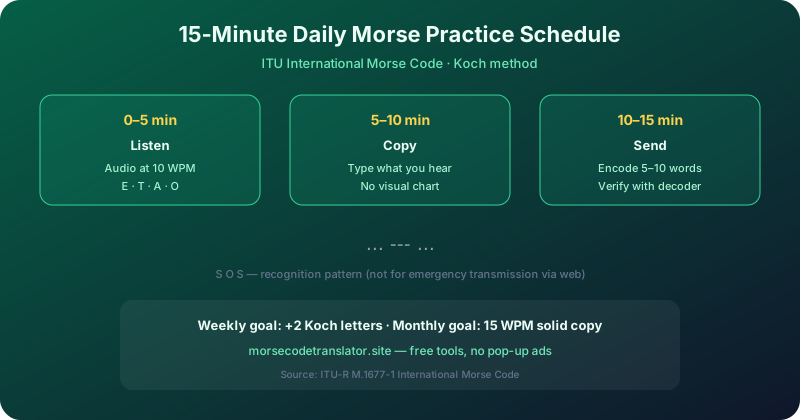
Fifteen Minutes That Actually Stick
Most people who quit Morse code did not fail because the code is hard — they failed because their practice was unfocused. An hour of random chart memorization on Sunday beats nothing, but it loses to fifteen deliberate minutes every day. That rhythm matches how Ludwig Koch designed his training method in the 1930s: small sessions, high repetition, and new material only when accuracy holds.
This plan targets International Morse Code per ITU-R M.1677-1, the same timing standard used on HF ham bands, maritime distress channels, and aviation beacons. You do not need a radio yet. You need headphones, a notebook, and the free tools linked below.
Why the Koch Method Fits a Short Session
Koch training never dumps the full alphabet on you at once. Session one might be only E (.) and T (-). You listen, you write, you check. When you hit roughly 90% accuracy on random five-character groups, you add one letter — never two. That constraint is why fifteen minutes is enough: the cognitive load stays bounded.
Contrast that with alphabet-chart cramming, where learners confuse similar patterns (B vs 6, F vs T) because nothing was heard in context. Koch forces context from day one.
Your 15-Minute Session Structure
Block the same time slot daily — morning coffee, lunch break, or the last fifteen minutes before bed. Structure beats motivation.
| Block | Duration | Activity | Goal |
|---|---|---|---|
| Warm-up | 2 min | Listen to known letters on the audio player | Wake your ear; no writing yet |
| New or drill | 5 min | Add one Koch letter OR drill weakest pair | Maintain 90% accuracy gate |
| Copy practice | 5 min | Write random groups as you hear them | Build pencil/keyboard copy speed |
| Encode review | 3 min | Spell three words on Text-to-Morse, listen back | Connect sound to spelling |
The warm-up uses only letters you already own. The drill block is where growth happens — one new character per session maximum. Copy practice mimics on-air conditions: imperfect rhythm, no visual hints. The encode review cements bidirectional skill, which chart-only learners skip and regret later.
Ear Training: The Non-Negotiable Skill
International Morse on the air is an auditory language. Your goal is to hear .- and think "A" before your conscious mind parses timing. That reflex is built through listening at controlled speed, not through flashing lights or wallpaper charts.
Farnsworth spacing in short sessions
The Farnsworth technique sends each character at a comfortable speed (often 10 WPM) while stretching pauses between characters and words toward your target pace (15 WPM). Your brain learns letter shapes without feeling rushed. When you remove the extra gaps, speed rises naturally.
- Character speed: 8–10 WPM while learning new letters
- Farnsworth word speed: 12–15 WPM gaps
- Increase rule: +2 WPM character speed per week at most
Full timing rules and prosigns live on our learning guide. The alphabet chart is your reference after sessions, not a substitute for audio.
Mid-Session Practice With the Translator
Halfway through your weekly rotation, encode a phrase you actually use — your call sign, a child's name, a QSO opener. Hearing your own text at ITU timing cements why spacing matters.
Advanced Controls
Sound Type
Live Signal Visualizer
Character Highlight
Prosigns
Type a five-word sentence, set 10 WPM with Farnsworth enabled, and copy it back from audio only. That closed loop — encode, listen, decode — exposes weak letters faster than passive listening alone.
L always breaks your rhythm. Drill it alone tomorrow.
ITU Timing in Plain Language
Spacing is part of the code. At any speed, one dot length equals 1.2 ÷ WPM seconds. Everything else scales from that unit per ITU-R M.1677-1:
- One dash equals three dot units
- Gap between elements within a character equals one dot unit
- Gap between letters equals three dot units
- Gap between words equals seven dot units (written as
/in text form)
Sloppy spacing creates ambiguous strings. The word "ET" and the letter "A" differ only in timing if you rush. Daily fifteen-minute sessions train muscle memory for those gaps as much as for dits and dahs.
Week-by-Week Expectations
Honest timelines prevent burnout. With fifteen focused minutes daily:
- Week 1: Solid E, T, A, O — copy two-letter groups cleanly
- Week 2: Eight to ten letters; first three-letter words by ear
- Week 3–4: Full alphabet at 10 WPM; simple sentences slowly
- Month 2+: Push toward 15 WPM; introduce numbers and prosigns
Operators who skip days lose letter reflex more than vocabulary — the Koch method assumes continuity. If you miss a day, repeat the last successful session instead of adding material.
What fifteen minutes should feel like
A well-run session feels almost too short — that is by design. You should finish slightly wanting one more drill, not drained. Mental fatigue shows up as counting dots again or dropping below seventy percent accuracy; when that happens, end early and protect tomorrow's session. Long-term retention studies on skill learning consistently show distributed practice beats massed practice for auditory discrimination tasks, which is exactly what Morse copy is.
Keep a single notebook page per week: columns for date, active letter set, WPM, accuracy, and notes. Patterns emerge quickly — perhaps L breaks rhythm every Thursday because you rush before lunch. Data beats guesswork.
Start Tonight
Set a timer for fifteen minutes. Open the audio player at 10 WPM. Listen to E and T until you can write twenty random characters without checking a chart. Log the result. Tomorrow, same time, same length — add A only if you cleared ninety percent. That is the entire secret: small steps, measured ears, daily repetition. The Koch method has trained radiotelegraph operators for nearly a century; your quarter-hour habit is how you join them.
Equipment you do not need yet
Beginners often delay practice until a paddle, transceiver, or club membership arrives. None of that is required for the first month. Laptop speakers and the audio player suffice. Add a cheap notebook for copy practice. When you eventually touch a key, your ears already know what correct timing sounds like — that head start matters more than key brand.
Pairing with structured curriculum
This daily block complements the full Koch sequence on /learn rather than replacing it. Use the guide for letter order and prosign introduction; use this article as your timer template. When the guide says add N, your next three daily sessions drill E, T, A, O, I, N exclusively before expanding. Discipline in the schedule converts curriculum into skill.
Weekend versus weekday sessions
Weekdays fit the fifteen-minute block; weekends optionally add five minutes of review-only listening without new letters. Review-only means E through your current set at five WPM below normal — cement reflexes without cognitive load. Avoid doubling session length on Saturday to compensate for skipped weekdays; irregular long sessions do not substitute for daily short ones in auditory skill research.
Consistency compounds: twelve weeks of fifteen-minute days equals roughly thirty hours of focused ear training — enough for many learners to hold rag-chew QSOs at thirteen WPM when paired with the Koch sequence on /learn. The investment fits between two streaming episodes. Choose the habit that builds a skill lasting decades.