Morse Code for Beginners: Complete Guide
New to Morse? Skip the wall chart. This guide covers Koch order, ITU timing rules, mistakes that slow progress, and free tools that replace a classroom.
Welcome to Morse Code — Start With Your Ears
Morse code survived telegraph wires, two world wars, and the smartphone era because it solves a stubborn problem: getting intelligible messages through noise with minimal power. For beginners in 2026, the path has never been more accessible — free browser tools, Koch-method trainers, and ITU-standard audio mean you can learn before buying a single radio component.
This guide assumes zero prior knowledge. We use International Morse Code (ITU-R M.1677-1), the global standard for amateur CW, maritime backup, and aviation identification beacons. American Morse variants exist in museums; on-air operation uses International timing everywhere that matters for newcomers.
What Morse Code Actually Is
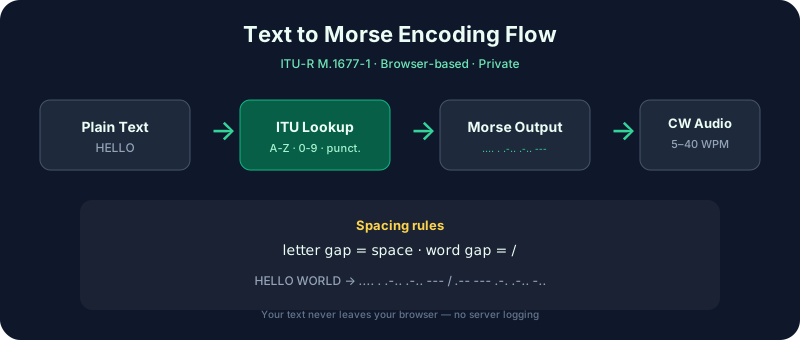
Morse encodes characters as timed sequences of short signals (dots, or dits) and long signals (dashes, or dahs). Spacing between elements, letters, and words carries meaning — sloppy timing creates ambiguous messages. Written form uses spaces between letters and a forward slash between words: HI becomes .... ...
CW — continuous wave — is the radio mode that carries Morse by switching a carrier on and off. You will hear operators say "CW" and "Morse" interchangeably on ham bands, though technically CW refers to the emission type and Morse to the encoding alphabet.
The Koch Method — Your Roadmap
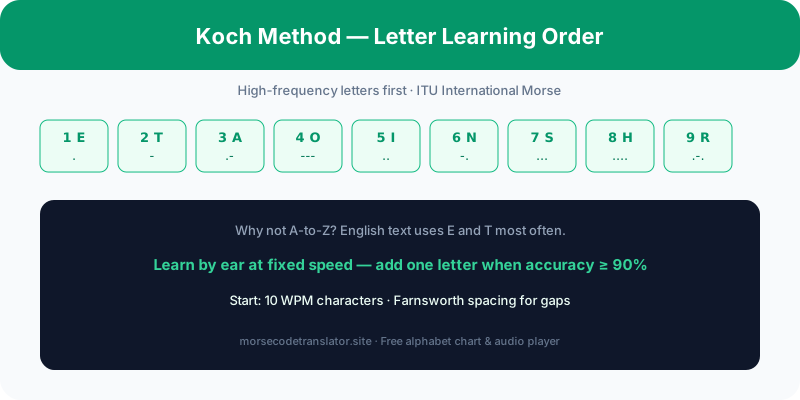
Ludwig Koch proved that incremental introduction beats mass memorization. Add one letter at a time; advance only at ninety percent copy accuracy on random five-character groups. The order below prioritizes letters common in English:
| Stage | Letters added | Morse patterns | Typical timeline |
|---|---|---|---|
| 1 | E, T | . - | Day 1–2 |
| 2 | A, O | .- --- | Week 1 |
| 3 | I, N | .. -. | Week 1 |
| 4 | S, H, R | ... .... .-. | Week 2 |
| 5 | D, L, C, U | -.. .-.. -.-. ..- | Week 2–3 |
| 6 | Remaining + digits | See alphabet chart | Weeks 3–6 |
Detailed weekly plans live on /learn. Resist skipping ahead — operators who rush to Z before solidifying E through N rebuild foundations later at double the cost.
Timing Rules You Cannot Ignore
ITU-R M.1677-1 defines relationships in dot units. At WPM speed, one dot equals 1.2 ÷ WPM seconds:
- Dash = 3 dot units
- Intra-character gap = 1 dot unit
- Inter-letter gap = 3 dot units
- Inter-word gap = 7 dot units (
/in text)
Farnsworth spacing for beginners
Send characters at 10 WPM but stretch pauses to simulate 15 WPM overall. Your brain learns letter shapes without panic. Remove extra gaps gradually as accuracy holds. Enable Farnsworth in the Advanced settings on /text-to-morse and the main translator.
Seven Mistakes That Stall Beginners
- Counting dots and dashes — Fluent copy is pattern recognition, not arithmetic. Slow down until each letter is one sound.
- Visual-only study — Flashcards without audio build fragile skills that fail on air.
- Adding multiple letters per session — Koch allows one new character per successful drill block.
- Chasing speed early — Accuracy first; add two WPM per week maximum.
- Ignoring spacing — Bad gaps make distinct words look like random letter strings.
- Skipping numbers and prosigns — Digits 0–9 and signals like AR and SK appear in every real QSO.
- Irregular practice — Ten minutes daily beats two hours on Saturday.
Free Tools on morsecodetranslator.site
You do not need hardware to reach first QSO-ready copy speed. Build a practice stack from these pages — all run in-browser without sign-up and without pop-up ads breaking your focus:
- Main translator — bidirectional encode/decode with Play, Copy, and WAV export
- /morse-code-audio — dedicated CW player for ear drills
- /morse-code-alphabet — ITU letter and prosign reference
- /text-to-morse — focused encoding workflow
- /morse-to-text — decode practice from typed dots and dashes
- /learn — structured curriculum with timing tables
A sensible first week: mornings on the audio player, evenings encoding three vocabulary words on text-to-morse, weekend copy test on morse-to-text. Log accuracy in a notebook.
From Beginner to On-Air Ready
Most beginners who follow Koch and Farnsworth reach comfortable rag-chew copy at 13–15 WPM within two to three months. Licensing comes separately — every country sets its own exam elements; verify with your regulator before transmitting. Until then, practice is unlimited on receive and with online encoders.
Morse rewards patience with a skill that feels like magic the first time you copy a stranger's call sign through static. Start with E and T today. Add A tomorrow only if your ear says yes. The alphabet has waited since 1844; it can wait one more day for you to get T solid.
Numbers, punctuation, and prosigns — when to add them
After roughly twenty letters at ten WPM, introduce digits 0–9 using the chart at /morse-code-numbers. Numbers share patterns with letters — 5 is five dots, easy to confuse with E at speed — so drill them separately before mixing QSO-style exchanges. Prosigns like AR and SK come next via the phrases reference; they appear constantly on air but rarely on beginner posters.
Building a sustainable study habit
Anchor practice to an existing routine: after breakfast, during a commute with headphones, or before bed. Habit stacking beats willpower. Track streaks in a calendar; missing one day is fine, missing three in a row rebuilds friction. Pair passive listening (audio player in background) with active copy (notebook in hand) — passive alone creates illusion of progress.
Measuring real progress
Progress markers for beginners: week two, copy three-letter words without pausing; week four, copy a callsign at ten WPM; week six, encode your name and decode it back through /morse-to-text without errors. If markers slip, reduce WPM before adding letters — speed follows accuracy, never the reverse.
Your first month calendar
Week one focuses on E, T, A, O only — no numbers, no prosigns. Week two adds I, N, S, H with daily five-minute copy blocks. Week three introduces R, D, L, C, U and begins Farnsworth removal experiments at twelve WPM. Week four completes the alphabet through Koch order and starts mixed-word drills from common phrase lists. Adjust if accuracy dips; the calendar is a template, not a race.
Why charts fail alone
Alphabet posters show static patterns; the air delivers rhythm with QRM, QSB, and operator fist individuality. Charts belong on the wall for lookup after sessions — open the alphabet page only when verifying a doubtful character, not as primary input. Teachers who lead with charts report higher dropout than teachers who lead with headphones and delayed chart introduction.
Connecting to ham radio later
When you pursue licensing, your ear training transfers directly to on-air CW. Many beginners arrive at exam day able to copy but not yet comfortable sending — that is normal. Sending skill develops with sidetone practice and elmer feedback; receiving skill develops with daily audio. The free tools listed above support both directions before you key a transmitter.
Accessibility and alternative input
Morse remains relevant in assistive technology — some operators with limited mobility use CW paddles as primary computer input. Beginners exploring accessibility applications should still learn ear-first for the same reasons as hams: timing and spacing carry meaning. Software encoders validate patterns while hardware skills develop separately.
Document your starting date and first successful five-letter copy — future you will appreciate the paper trail when plateaus feel permanent. Every fluent operator was once stuck on T versus E.